


In 2026, every software vendor claims to offer "AI-powered automation."
Most of the time, this is marketing hype slapped onto basic, decade-old technology: a linear "If This, Then That" script that sends an automated email when a contact form is submitted.
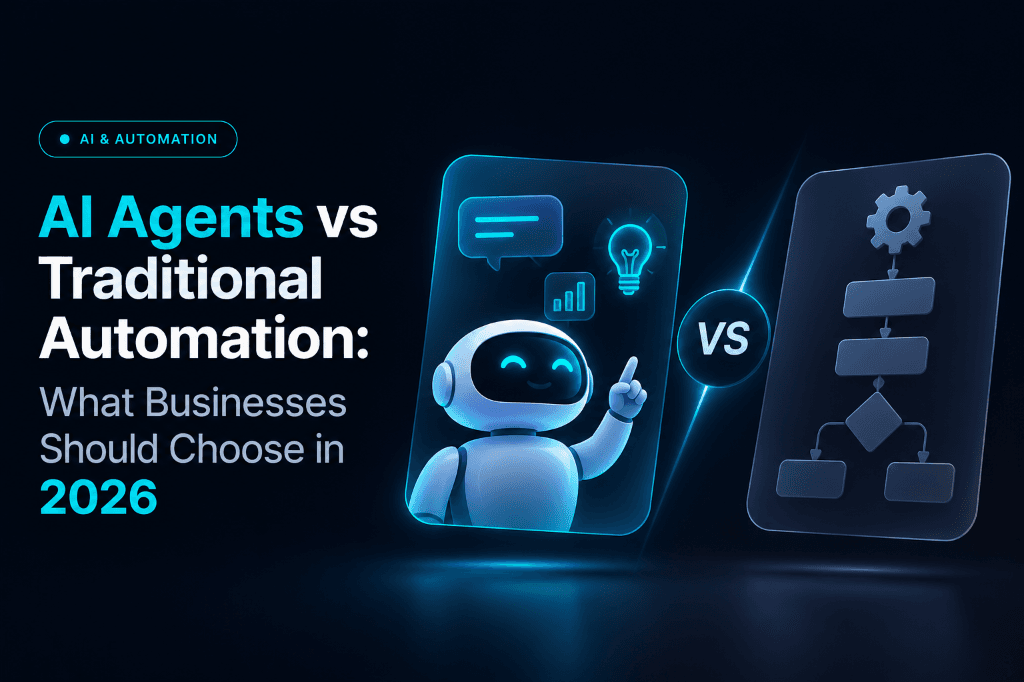
True Autonomous AI Agents represent a profound architectural paradigm shift. They do not follow rigid, pre-programmed decision trees. They possess cognitive reasoning loops capable of interpreting unstructured data, formulating multi-step execution strategies, and using software tools to accomplish real business objectives.
What is the real difference between traditional automation and autonomous AI agents? Which does your business actually need? And how do you combine both to build an unstoppable operational engine?
Head-to-Head Comparison: The Core Architectural Difference
CAPABILITY                  TRADITIONAL AUTOMATION (RPA/ZAPIER)    AUTONOMOUS AI AGENT
────────────────────────────────────────────────────────────────────────────────────────
Execution Model             Deterministic (If A, then B)           Cognitive (Goal-driven reasoning)
Data Compatibility          Structured data only (JSON, tables)    Unstructured (audio, text, PDFs)
Exception Handling          Crashes on unexpected inputs           Self-corrects and adjusts strategy
Tool Utilization            Follows 1 fixed API call               Selects and chains tools dynamically
Adaptability                Zero adaptability (rigid)              High adaptability to client context
Cost Profile                Low per-run cost                       Variable token cost with high ROI
1. Traditional Automation: The Fast & Brittle Muscle
Traditional automation (such as Zapier, Make, or legacy Robotic Process Automation) operates on strict deterministic rules:
- When a form is submitted on Webflow, create a row in Google Sheets, and send a Slack message.
Where It Shines:
Executing repetitive, structured tasks with 100% mathematical certainty where inputs never vary and zero judgment is required.
Where It Fails:
The moment an input deviates by one character, traditional automation breaks. If a prospective client types "Hey, looking for a 3-bedroom villa in Palm Jumeirah around 15M AED, can we chat Thursday?" into a general comments box, a traditional script has no ability to extract the property type, parse the budget, evaluate urgency, or compose a tailored reply.
2. Autonomous AI Agents: The Cognitive Brain
An AI agent combines high-capacity Large Language Models (LLMs) with tool-calling architecture and contextual memory:
  [ INCOMING INQUIRY ]
          │
          ▼
┌──────────────────┐      1. Perceives unstructured customer message
│  REASONING LOOP  │ ───► 2. Identifies: Intent = Buying; Budget = 15M AED; Area = Palm
│  (Cognitive LLM) │ ───► 3. Formulates Action Plan: Check database ➔ Draft WhatsApp
└─────────┬────────┘
          │
          ▼
┌──────────────────┐
│  TOOL EXECUTION  │ ───► 1. Executes SQL query on inventory database
│  (APIs & Tools)  │ ───► 2. Generates personalized PDF unit brochure
│                  │ ───► 3. Dispatches customized WhatsApp message via Cloud API
└──────────────────┘
An AI agent does not just move data—it makes contextual business decisions.
3 High-Impact Real-World Use Cases for AI Agents
1. Inbound Lead Qualification & Instant Engagement
- Traditional Automation: Sends a generic template email: "Thank you for contacting us, an agent will reach out in 24 hours."
- AI Agent: Reads the inquiry, queries the CRM database for relevant projects matching the client's criteria, drafts a personalized voice or text message on WhatsApp within 30 seconds, and books an appointment directly onto the sales rep's calendar.
2. Autonomous Contract & Document Extraction
- Traditional Automation: Requires the document to be a standardized form with exact pixel coordinates. Fails if a single line shifts.
- AI Agent: Ingests unformatted PDFs, vendor invoices, or scanned purchase agreements, extracts key commercial terms (line items, payment milestones, penalty clauses), and normalizes the data into your database with 99.8% precision.
3. Predictive Client Churn & Account Health Monitoring
- Traditional Automation: Flags an account only when a contract cancellation button is clicked.
- AI Agent: Continuously analyzes client email sentiment, ticket resolution times, and feature usage patterns—alerting account directors two months before renewal that a client is demonstrating signs of dissatisfaction.
The Winning Architecture: The Cognitive Engine
The most effective systems do not abandon traditional automation; they fuse both into a unified Cognitive Engine:
- Use Deterministic Pipelines for reliable data movement, database transactions, and financial billing where 100% consistency is required.
- Use Autonomous AI Agents at the interfaces: interpreting client requests, qualifying inbound intent, and routing decisions.
Deploy Custom AI Agents with Orcashel
At Orcashel, we build and integrate purpose-built AI agents directly into your custom platforms, CRMs, and client portals—hosted securely on your private cloud with strict data privacy.
👉 Calculate your AI & custom software investment on our Estimator
👉 Schedule a 15-Minute AI Architecture Consultation